/cdn.vox-cdn.com/uploads/chorus_asset/file/24016885/STK093_Google_04.jpg)


/cdn.vox-cdn.com/uploads/chorus_asset/file/24808816/Starfield__The_Settled_Systems___Supra_Et_Ultra_____Starfield__The_Settled_Systems___Supra_Et_Ultra_2023_7_25_94252.263_1440p_streamshot.png)









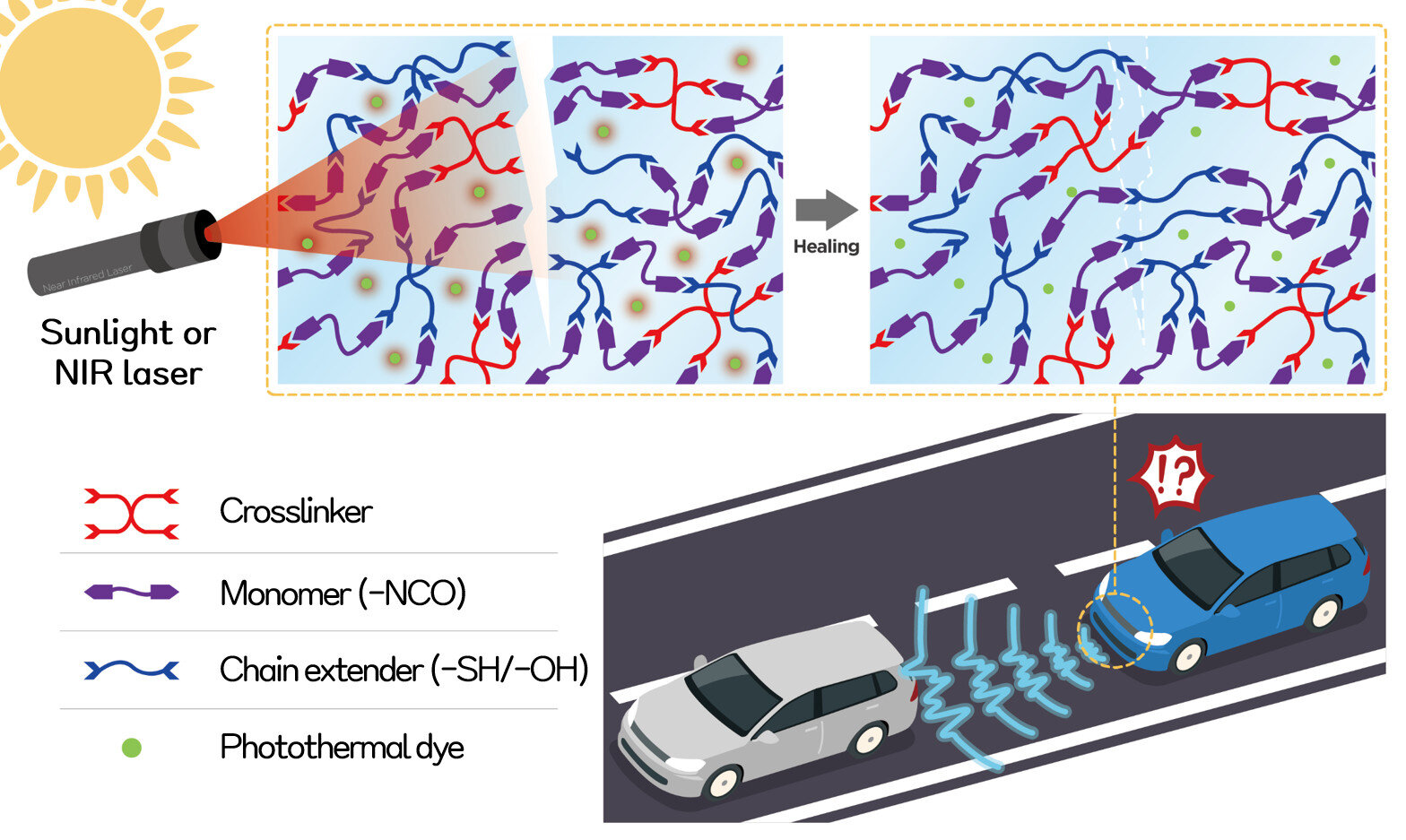

Self-healing mechanism of lens material for self-driving cars based on dynamic polymer network and photothermal dye. Credit: Korea Research Institute of Chemical Technology (KRICT)
The safety issues of self-driving cars have come to the fore due to frequent traffic accidents. A self-healing lens material has been developed that can prevent car accidents caused by signal distortion by healing scratches on the sensor surface of self-driving cars.
The Korea Research Institute of Chemical Technology (KRICT) research team is led by Dr. Kim Jin Chul, Park Young Il, and Jeong Ji-eun and Prof. Kim Hak-rin and Prof. Cheong In Woo at Kyungpuk National University (KNU). Developed a material that heals scratches on sensors of autonomous vehicles. work is published in the journal ACS Applied Materials and Interfaces,
When this self-healing optical material is used in the sensor of an autonomous vehicle, the life expectancy of the product can be extended, and future technologies that prevent malfunction due to surface damage can be anticipated. Could
A lens is a device that collects or disperses light and is used in many everyday optical devices such as cameras, cell phones, and eyeglasses. However, if the surface of the lens is damaged by scratches, the image or optical signal received by the optical device may be severely distorted.
Recently, traffic accidents caused by detection errors and malfunctions in vision systems such as LiDAR sensors and image sensors of self-driving cars have occurred repeatedly. As a result, confidence in the safety of self-driving cars is low.
The KRICT-KNU joint research team has developed a transparent lens material that can remove scratches on the surface of the sensor within 60 seconds when sunlight is focused using a simple instrument such as a magnifying glass.
Because self-healing is favorable when molecular movement is free within the polymer, flexible materials typically provide excellent self-healing performance. However, the lenses or protective coating materials are made of rigid materials, and thus are difficult to provide a self-healing function. To solve this problem, the research team combined a thiourethane structure, which is already being used as a lens material, and a transparent photothermal dye to design a “dynamic chemical bond”. added in which the polymers repeat dissociation and recombination under the irradiation of sunlight.
In particular, developed transparent organic photothermal dye image sensors and the near-infrared region (350–850 nm) with a specific near-infrared wavelength (850–1050 nm) without interfering with the visible light region (350–850 nm) can selectively absorb light. ~1550 nm) are used for LiDAR sensors.
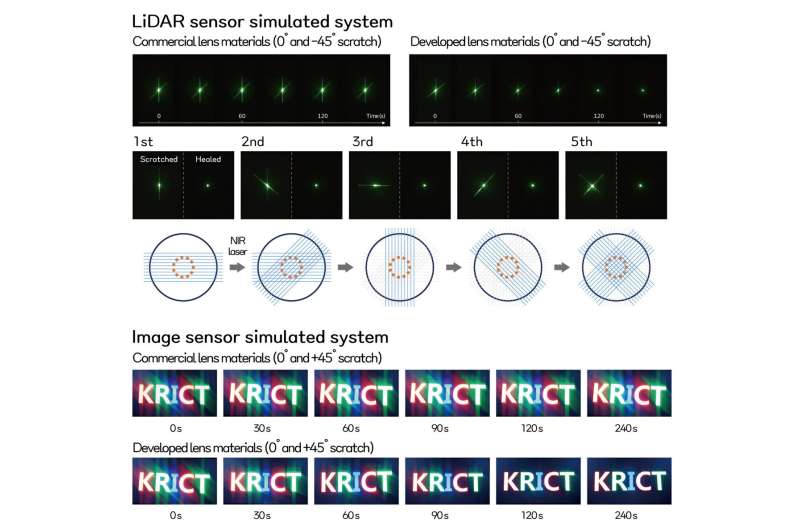
Optical signal recovery in LiDAR and image sensor simulated systems after self-healing of the scratched surface of the developed lens material with NIR light irradiation. Credit: Korea Research Institute of Chemical Technology (KRICT)
When sunlight is absorbed by the photothermal dyes, the surface temperature of the developed lens material rises as the light energy is converted into thermal energy. Subsequently, the increased surface temperature makes it possible for surface scratches to self-heal by repeating dissociation and recombination of chemical bonds in the polyurethane structure.
The developed lens material shows complete self-healing even when scratches cross each other, and provides excellent flexibility, maintaining 100% of the self-healing efficiency, even if the scratch at the same location and the healing process are repeated five times. is repeated more than once.
“This technology is a platform technology to synthesize a self-healing lens material using both an inexpensive high-refractive polymer material and a photothermal dye,” said Dr. Lee Young Kuk, president of KRICT. are expected to be used in autonomous vehicle sensors as well as glasses and cameras.”
more information:
Ji-Eun Jeong et al, NIR-Triggered High-Efficiency Self-Healable Protective Optical Coating for Vision Systems, ACS Applied Materials and Interfaces (2023). DOI: 10.1021/acsami.2c21058
Provided by National Research Council of Science and Technology
Citation: Development of self-healing lens material to prevent traffic accidents in self-driving cars (2023, 22 May) Retrieved 22 May 2023
This document is subject to copyright. No part may be reproduced without written permission, except in any fair dealing for the purpose of private study or research. The content is provided for information purposes only.